Vekt
Know what's in your lockfile before it ships
Vekt reads every lockfile in your repo and asks OSV.dev about each package: malicious code, known vulnerabilities and npm's security placeholders. It runs in your terminal, your editor and your CI. It's free, and there's no account.


Install · 0.1.1
Install
The script picks your platform, downloads the release and checks its SHA-256 before it installs anything.
- Free. No API keys, no accounts, no rate limits.
- Vekt is built and maintained by Kief Studio.
curl -fsSL https://kief.dev/vekt/install.sh | bashirm https://kief.dev/vekt/install.ps1 | iexReal output
See it in action
One run of vekt scan over every lockfile in a production codebase, as it printed.
$ vekt scan ~/projectsScanning 221 lockfiles in ~/projects ... Querying OSV for 14,208 unique packages (69,419 total) ... SCAN COMPLETE: 221 lockfiles | 69,419 packages | 1,702 findings CRITICAL: 0 MALICIOUS package(s) INFO: 1 security-holder placeholder(s) WARNING: 3,872 known vulnerability(ies) --> package-lock.json (npm) HOLDER MAL-2025-21003 fs@0.0.1-security registry placeholder, remove from dependencies --> uv.lock (PyPI) VULN GHSA-5239-wwwm-4pmq pygments@2.19.2 Ecosystems: PyPI, npm, crates.io, Go, Packagist, SwiftURLRun time: 46.1s
What Vekt does
Supply chain threat intelligence for package lockfiles. Scan your dependencies for malicious packages, known vulnerabilities, and typosquat risks across 12 ecosystems and 22 lockfile formats.
What Vekt does
Vekt reads your lockfiles, queries threat intelligence databases, and surfaces findings before they reach production. It detects confirmed malicious packages, known CVEs and security advisories, and npm security-holder placeholders that should be cleaned from your dependency tree. You get results in seconds with no configuration required.
Key features
- 22 lockfile formats across 12 ecosystems -- PyPI, npm, crates.io, Go, RubyGems, Packagist, NuGet, Pub, SwiftURL, Hex, Hackage, CRAN
- Pre-install scanning --
vekt audit express@4.18.2checks a package before you install it - CI/CD mode --
vekt ci --fail-on malicious --format sarifwith severity thresholds and SARIF output for GitHub Advanced Security - Ignore management --
.vektignorefiles with wildcard patterns and expiry dates viavekt ignore add/list/remove - Malicious package detection -- flags packages confirmed as malicious (MAL-* advisories)
- 5-platform binaries -- Linux x86_64/aarch64, macOS Intel/Apple Silicon, Windows x86_64
- Polished terminal UI -- box-drawing, unicode severity badges, branded output
- JSON + SARIF output -- structured output for CI systems and security dashboards
- LSP server -- in-editor diagnostics, hover info, and code actions with fixed-version suggestions via
vekt-lsp - Browser extension -- trust badge overlay on npm, PyPI, crates.io, and other registry pages
How it works
Step 1 -- Scan your project
vekt scan .
Vekt discovers all lockfiles in the directory tree, skipping node_modules, target, .venv, and other build artifact directories.
Step 2 -- Threat intel query
Vekt queries the threat intelligence database with all packages found in your lockfiles. Duplicate packages across multiple lockfiles are deduplicated before the query, so a package present in both package-lock.json and yarn.lock counts as one query.
Step 3 -- Findings report
Results are printed to stdout. Each finding is labeled MALICIOUS, VULN, or HOLDER. The exit code reflects whether findings were detected, so the command integrates cleanly into scripts and CI pipelines.
SCAN COMPLETE: 3 lockfiles | 847 packages | 2 findings

  CRITICAL: 1 MALICIOUS package(s) detected!
  WARNING: 1 known vulnerability(ies)

--> package-lock.json (package-lock.json)
    MALICIOUS MAL-2024-0001 evil-pkg@1.0.0 -- Exfiltrates environment variables on install
           https://osv.dev/vulnerability/MAL-2024-0001
    VULN GHSA-xxxx-yyyy-zzzz lodash@4.17.15 -- Prototype pollution in defaultsDeep
           https://osv.dev/vulnerability/GHSA-xxxx-yyyy-zzzz
Supported ecosystems
| Ecosystem | Registry | Lockfiles |
|---|---|---|
| PyPI | pypi.org | uv.lock, requirements.txt, poetry.lock, pdm.lock, Pipfile.lock, pixi.lock |
| npm | npmjs.com | package-lock.json, bun.lock, yarn.lock, pnpm-lock.yaml |
| crates.io | crates.io | Cargo.lock |
| Go | pkg.go.dev | go.sum |
| RubyGems | rubygems.org | Gemfile.lock |
| Packagist | packagist.org | composer.lock |
| NuGet | nuget.org | packages.lock.json |
| Pub | pub.dev | pubspec.lock |
| SwiftURL | Swift Package Index | Package.resolved |
| Hex | hex.pm | mix.lock, rebar.lock |
| Hackage | hackage.haskell.org | cabal.project.freeze, stack.yaml.lock |
| CRAN | cran.r-project.org | renv.lock |
Get started
# Install (Linux/macOS)
curl -fsSL https://kief.dev/vekt/install.sh | bash

# Scan your project
vekt scan .

# Check a package before installing
vekt audit express@4.18.2

# CI/CD mode with SARIF output
vekt ci --fail-on malicious --format sarif .
See the quickstart guide for a complete walkthrough.
Built by Kief Studio
Get the browser extension from the Chrome Web Store (opens in a new tab)
Browser extension
Trust data where you pick packages
Vulnerabilities, maintainer history and security signals on npm, PyPI, crates.io and the other registries, right on the package page. No tab switching.
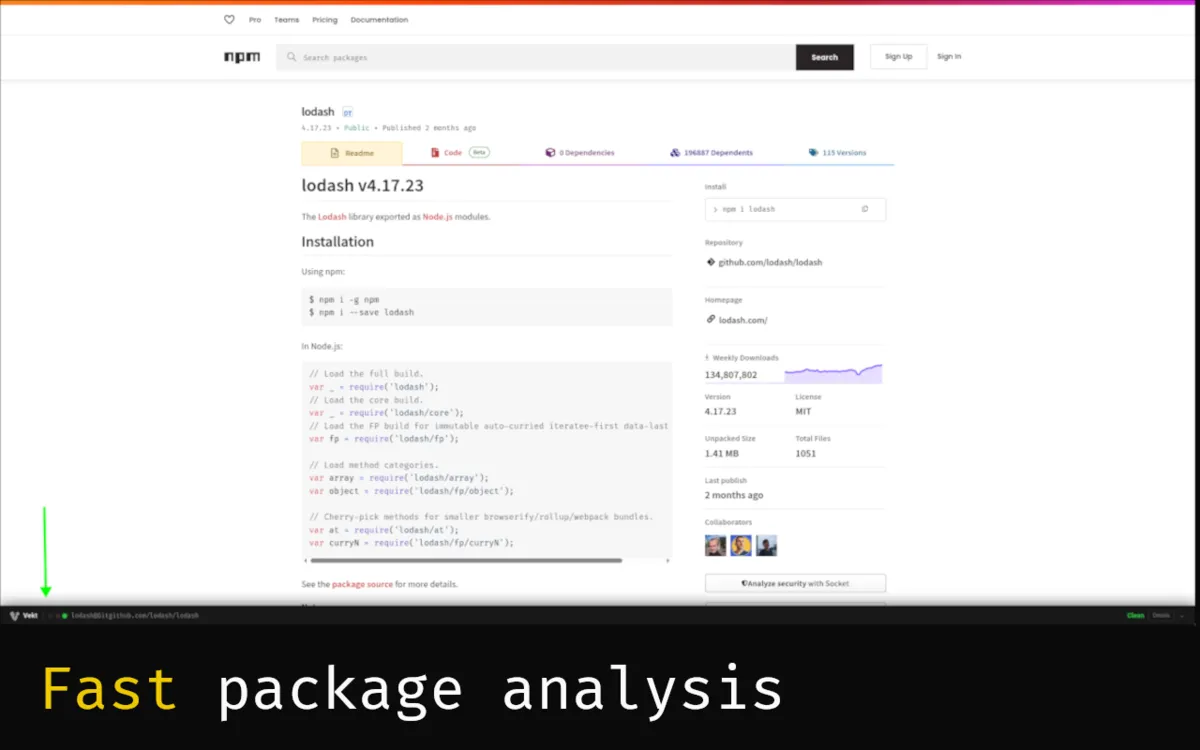
Instant analysis
A trust bar on every supported registry page: green, yellow or red, no security background needed.
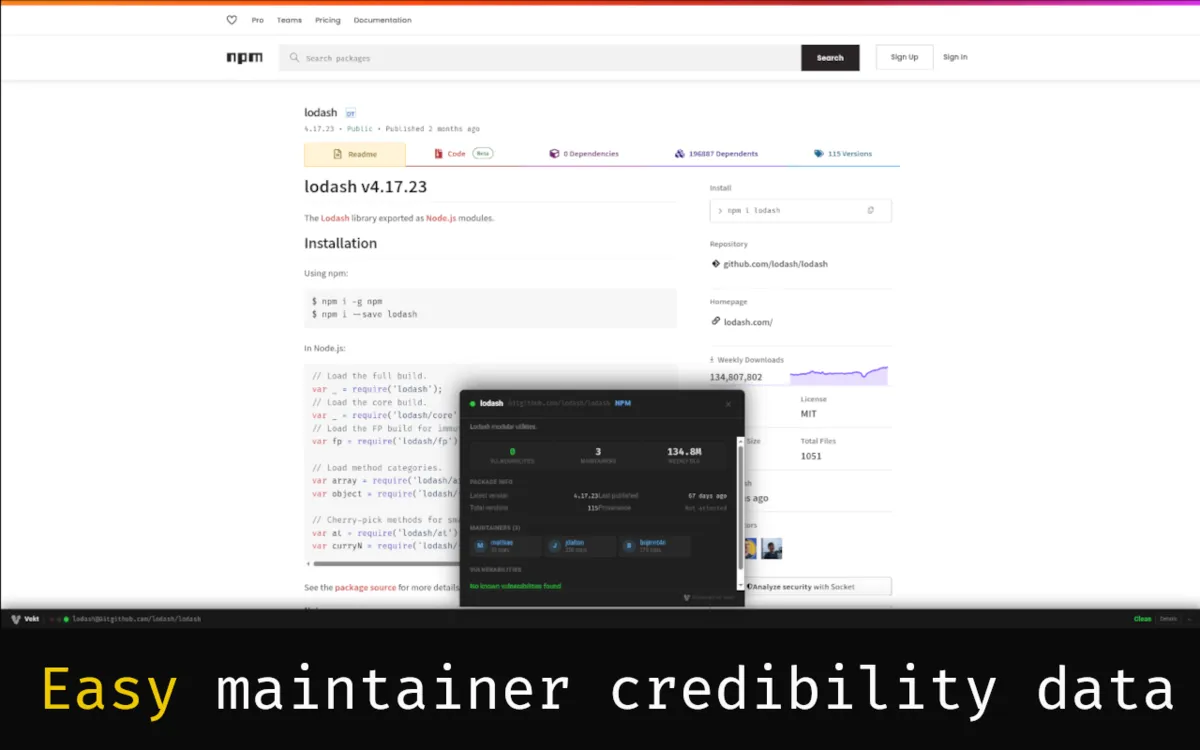
Maintainer credibility
Click it for the full panel: OpenSSF score, known vulnerabilities, maintainers, dependency depth and provenance.
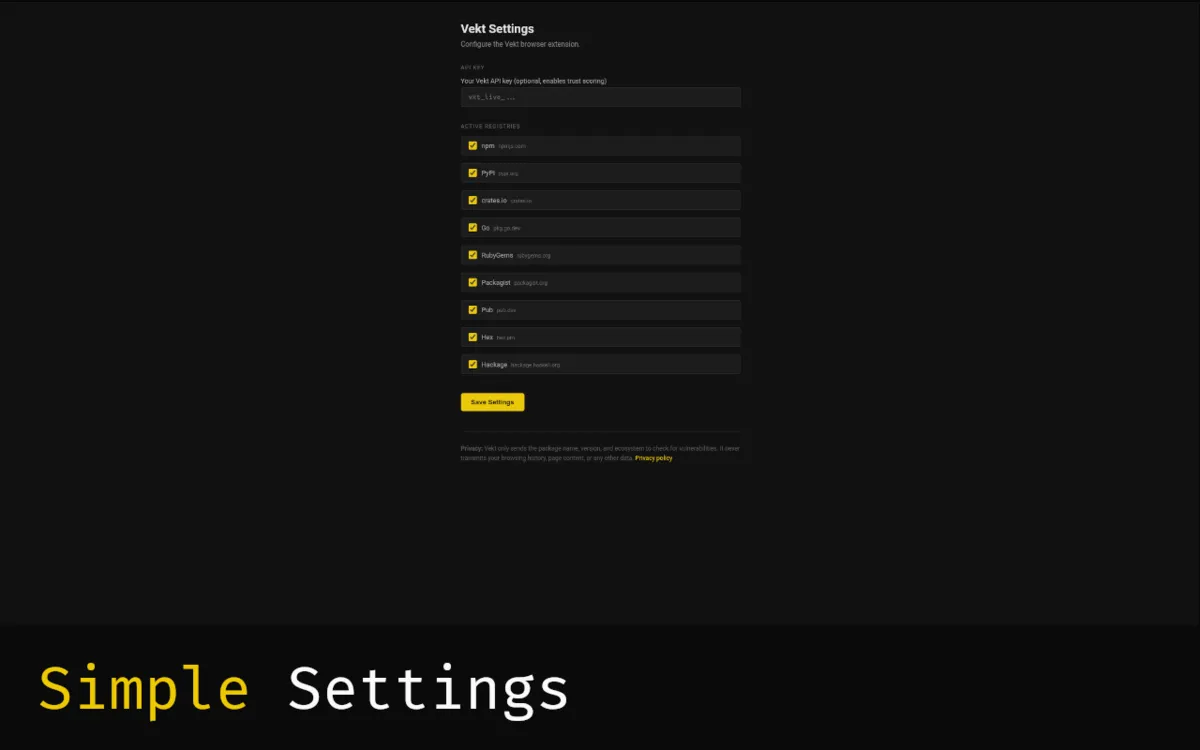
Simple settings
Turn registries on or off. It sends the package name and version, never your browsing.
Every ecosystem it reads
Each lockfile format is parsed natively in Rust, so Vekt reads what your package manager actually resolved.
 npm
 PyPI
 crates.io
 Go
 RubyGems
 Packagist
 NuGet
 Pub
 Swift
 Hex
 Hackage
 CRAN
Lockfiles Vekt reads
uv.lockrequirements.txtpoetry.lockPipfile.lockpackage-lock.jsonbun.lockyarn.lockpnpm-lock.yamlCargo.lockgo.sumGemfile.lockcomposer.lockpubspec.lockPackage.resolvedmix.lockrebar.lockpackages.lock.jsoncabal.project.freezestack.yaml.lockrenv.lockpdm.lockpixi.lock
Read the docs
Everything the CLI, the language server and the browser extension do.
Quickstart
Install the Vekt CLI, run your first lockfile scan, read the output, and add it to CI.
CLI Reference
Every Vekt CLI command, flag, exit code and environment variable, plus the .vektignore file format.
CI/CD Integration
Gate builds on supply chain findings with vekt ci: GitHub Actions, GitLab CI, SARIF output and exit codes.
Supported Lockfiles
Every lockfile format and ecosystem Vekt scans, with version notes and language server manifest support.
IDE Setup
Set up vekt-lsp for supply chain diagnostics in VS Code, Neovim, Zed, Helix, Sublime Text, JetBrains and Emacs.
Browser Extension
The Vekt browser extension adds a trust badge and typosquat warnings to package registry pages.
API Reference
Vekt is local-first and has no cloud API. All scanning runs on your machine through the CLI.
FAQ
Answers about Vekt: cost, offline use, private registries, false positives, finding types, trust scores and the browser extension.